Most of us spent the majority of our lives using the terms ‘God’ and ‘the LORD.’ It was simple and we knew that we were talking about the God of the Bible. But, when we came to the understanding of Torah, we rightly came to the understanding that He has a personal name, YHVH. How exciting it was to learn that our Creator has a name with meaning, rather than just a title!

Yet, somewhere in the excitement we may have lost our way. We elevated those Hebrew letters to gospel status and declared that the pronunciation was part of our salvation. Some verses could be misconstrued to come to this conclusion.
There is salvation in none other, for neither is there any other name under heaven, that is given among men, by which we must be saved!”
(Act 4:12)
That verse can be cherrypicked quite effectively to mean that we must have the right name to be saved.
But, what if we are looking at it all wrong?
If you have been in this Torah journey for more than five minutes, you have probably heard the comparison between Hebrew and Greek thinking. Hebrew thought focuses on the function. Greek thought focuses on form. If you ask a Greek philosopher to define a pencil, they will describe a yellow cylinder made of wood with graphite in the middle and a rubber eraser on one end. If you ask the same question in Hebrew thought, a pencil is something to write with. The emphasis is on action rather than physical form.
What if this whole very divisive debate about the pronunciation of Yah’s name is a result of looking at it through a Greek lens, rather than a Hebrew one? What if we focused on function rather than form? Would these verse references to His name look different?
His name in form
The Hebrew letters in the alephbet are unique in that they serve more purpose than just phonetics. Each Hebrew letter has a meaning and when combined into a word, these individual meanings help define the word as a whole. Yah’s name, often referred to as the tetragrammaton, can be better understood when looking at the meaning of the letters.
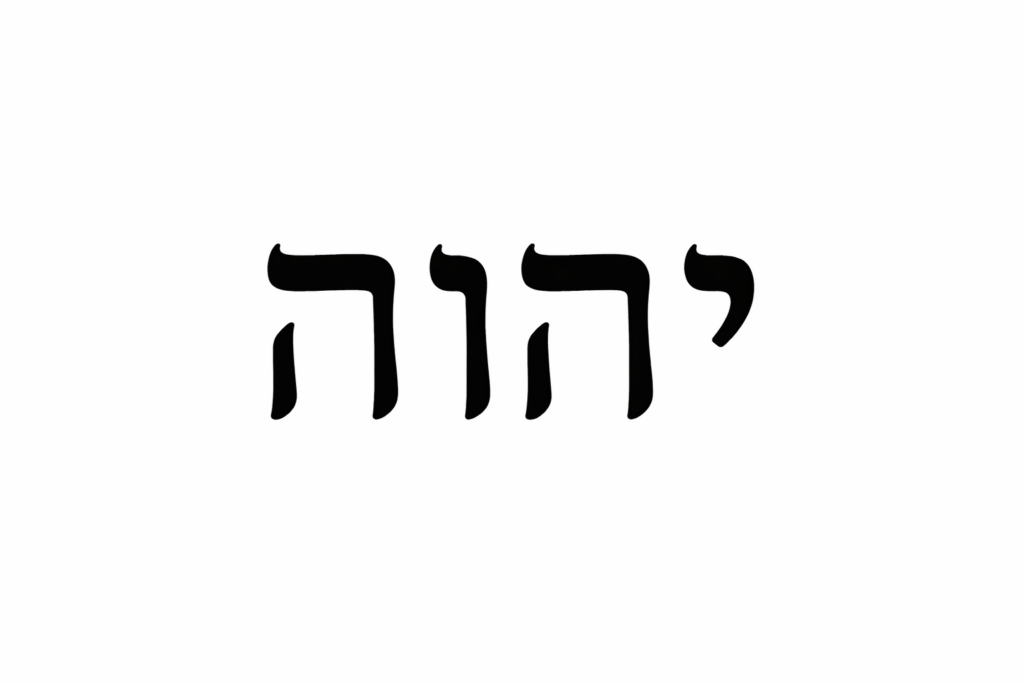
- Yod – Hand or right arm
- Hey – Behold
- Vav – Nail, fastener, tent peg
- Hey – Behold
When we look at the meaning of the letters together, we see a neon sign pointing to the work of the Messiah to bring us back into right relationship with Yah. This helps us understand the significant difference between the God of Abraham, Isaac, and Jacob – and pagan gods. Our Creator, the one true God, has defined Himself in His name as the God who is personally interested in His creation, mankind. He has put forth a plan from before the foundation of the earth to bring us back from our fallen state and redeem us. The pagan gods, on the other hand, are defined by chaos and selfishness.
At this point, we all agree.
Beyond this point, I see nothing but unnecessary division. Beyond these four letters, we start arguing about vowel points, pronunciations, and similarities to the sound of pagan god names. We are looking at the appearance of His name, the sound of His name, but nothing is gained by such a pursuit.
- We are not led to a deeper understanding of who our God is.
- We are not investing in our relationship with Him.
- We do not pursue obedience as a result.
We do, however, often create division among the brethren by claiming that we have come to the only correct understanding. Some even go so far as to connect pronunciation with salvation. Where we are supposed to be one in the body, united in purpose, helping and lifting each other up, instead we are breaking fellowship, casting judgment, and isolating ourselves.
His name in function
But, what if we looked at the function of His name instead?
A good name is more desirable than great riches, and loving favor is better than silver and gold.
(Pro 22:1)
A good name is better than fine perfume; and the day of death better than the day of one’s birth.
(Ecc 7:1)
The memory of the righteous is blessed, but the name of the wicked will rot.
(Pro 10:7)
So you will have grace and a good name in the eyes of God and men.
(Pro 3:4)
Throughout Scripture, a person’s name represents their character.
My name is often misspelled. I have seen everything from Heide to Hidie to Hide. That does not represent who I am, thankfully. (especially the last one lol) Having a good name is seen in how others perceive my actions. They may recognize my work ethic in filling orders. They may look at my children and compliment my parenting. These are reflecting back on my name, my character. The spelling of my name is irrelevant aside from giving me a chuckle.
Do you see the difference?
When we focus on Yah’s name as a representation of His character, we will look at His goodness and also His wrath. We will see His love and His jealousy. We see His holiness, His omniscience, and His desire to have relationship with us. We can spend a lifetime studying our Elohim and never exhausting the immenseness of who He is. With every discovery, we are humbled and drawn closer to Him.
When we learn of His judgment, we are motivated to obey.
When we see His love and provision, we are moved to gratitude.
When we understand His heart for people, we want to share His word with others.
Understanding His character (His name) brings us into closer relationship with Him.
When He says there is no other name in Acts 4:12, He is showing us that He is the One True God who provided a way for salvation. No pagan god planned and executed redemption as Yah did through His son Yeshua the Messiah. It is not the pronunciation of His name that saves. It is the essence of His character.
Conclusion
If we limit our understanding of a pencil to a yellow cylinder with a rubber eraser, we may never realize that we can use it to write. Likewise, if we focus solely on the sound or appearance of Yah’s name, and even worse, judge others for coming to a different conclusion, we are never improving our relationship with Him, and never walking in more obedience than the day before.
Should we try to learn His name? Yes! He is a God with a personal name, and being able to use HIs name with reverence and love brings intimacy to our relationship with Him. Do your best to understand the Hebrew letters. Ask Him what you should call Him.
But please be careful. Don’t elevate a pronunciation above His character and make demands of others to see it your way. Rather, encourage fellow believers to come to a better understanding of His character. Help them to see His attributes, and how they should respond. This brings unity and growth to Yah’s people. This is what Yeshua was praying for us in John 17. All our discussions and midrash should bring us to a higher level of obedience and a better understanding of what it means to love each other. And it should also constantly remind us of how awesome our Elohim is!








You must be logged in to post a comment.